Every year, the global personal care industry generates more than 8 million tons of plastic packaging waste, and synthetic sponges account for a significant share of that burden. Meanwhile, a vine-grown gourd cultivated along the banks of the Nile has been quietly demonstrating how natural loofah sustainable agriculture can offer an entirely different path forward. Loofah farming requires no petroleum inputs, generates zero microplastic waste, and produces a crop that is fully biodegradable within weeks of disposal.
This is not simply a feel-good story about a niche plant. The Luffa aegyptiaca gourd represents one of the clearest examples of how agricultural practices and consumer product manufacturing can align with environmental goals without sacrificing performance, quality, or commercial viability. For the individual shopper looking for a plastic-free bath sponge, understanding the farming practices behind the product transforms a simple purchase into an informed act of environmental participation. For the wholesale buyer, retailer, or spa owner building a product line, tracing the agricultural roots of your inventory creates a supply chain narrative that today’s sustainability-focused customer actively seeks out.
This article examines natural loofah sustainable agriculture from every angle. You will find data on water usage, soil impact, and carbon footprint. You will see how Egyptian loofah cultivation, led by experienced growers like Egexo with over 25 years in the field, sets the global benchmark for quality and sustainability. You will discover practical evaluation frameworks for sourcing decisions, composting guidance for end-of-life product handling, and a clear picture of how this ancient crop fits into the modern zero-waste movement.
Whether you are comparing suppliers for a wholesale order or choosing your next shower scrubber, the agriculture behind your loofah matters. Here is why.
If you are ready to explore sustainably farmed Egyptian loofah products now, browse the full collection at Egexo or request a wholesale quote to start sourcing.
What Makes Natural Loofah a Cornerstone of Sustainable Agriculture
Sustainability in agriculture is measured by how a crop interacts with the land, water, and communities that produce it. By nearly every metric, loofah farming qualifies as one of the most environmentally gentle forms of commercial cultivation practiced today.
The Botany Behind the Sustainability
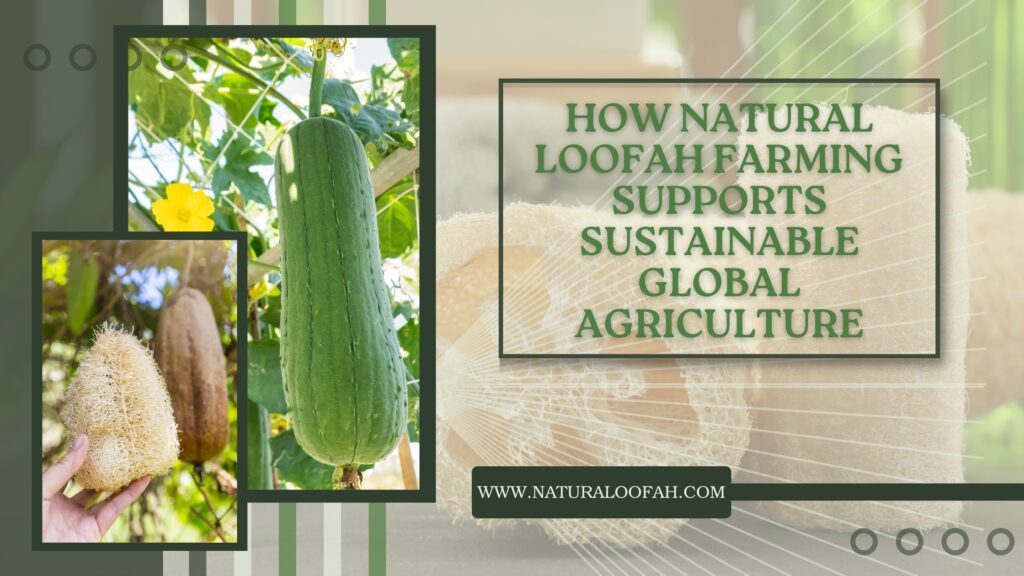
Luffa aegyptiaca is a vigorous climbing vine in the Cucurbitaceae family, closely related to cucumbers and squash. It grows rapidly during warm seasons, reaching lengths of 15 to 30 feet in a single growing cycle. The plant produces large yellow flowers that attract pollinators, and its broad leaves create dense canopy cover that shades the soil beneath, reducing moisture evaporation and suppressing weed growth naturally.
The harvestable product is not the fruit’s flesh but its internal vascular skeleton, a dense network of cellulose fibers that forms as the gourd matures and dries on the vine. This means the crop’s commercial value comes from its structural fiber rather than from water-heavy edible tissue, which makes it remarkably resource-efficient compared to other agricultural products.
Low Input Requirements
Unlike cotton, which demands heavy irrigation and often relies on synthetic pesticides, or palm oil, which drives tropical deforestation, loofah farming operates on a fundamentally lighter footprint. Mature loofah vines are naturally resistant to many common pests. They thrive in warm climates with moderate rainfall and do not require the intensive chemical programs that define so many large-scale agricultural operations.
Egyptian loofah cultivation in the Nile Delta benefits from some of the richest alluvial soil on Earth. The natural fertility of this land reduces the need for synthetic fertilizers, and traditional growing methods passed down through generations of farming families prioritize soil health over short-term yield maximization. You can see the full journey from field to finished product through Egexo’s farm to export documentation.
Summary: Loofah farming is inherently sustainable because the crop requires minimal water, resists pests naturally, builds soil cover, and produces a fiber-based product with no plastic or synthetic inputs.
The Environmental Footprint of Natural Loofah Farming Compared to Alternatives
When consumers and buyers ask about natural loofah sustainable agriculture, they often want to see how it compares to the alternatives. The contrast between loofah cultivation and synthetic sponge manufacturing is striking across every environmental category.
Resource Comparison: Natural Loofah vs Synthetic Sponge Production
| Environmental Factor | Natural Loofah Farming | Synthetic Sponge Manufacturing |
|---|---|---|
| Primary raw material | Luffa aegyptiaca gourd (renewable plant) | Petroleum-derived polymers (non-renewable fossil fuel) |
| Water consumption per unit | 8 to 15 liters (rain-fed and irrigation combined) | 20 to 40 liters (industrial process water, cooling) |
| Carbon emissions per 1,000 units | 30 to 50 kg CO2 equivalent | 150 to 300 kg CO2 equivalent |
| Pesticide requirement | Minimal to none (natural pest resistance) | Not applicable (factory setting, but chemical processing required) |
| Soil impact | Positive (root systems improve soil structure, vine canopy prevents erosion) | None (manufactured in factories, no agricultural soil interaction) |
| Biodegradability of finished product | Fully biodegradable in 30 to 90 days | Non-biodegradable, persists 200 to 1,000+ years |
| Microplastic generation during use | Zero | Releases fibers with every use |
| End-of-life pathway | Home composting, garden burial, commercial compost | Landfill or incineration only |
| Energy source for production | Solar energy (photosynthesis) | Fossil fuels and industrial electricity |
| Packaging potential | Paper, compostable wrapping | Typically plastic blister packs or shrink wrap |
The numbers tell a clear story. Natural loofah farming produces a functional scrubbing product at a fraction of the environmental cost of its synthetic counterpart. Every category from carbon output to end-of-life disposal favors the plant-based option.
Carbon Sequestration During Growth
One often overlooked benefit of loofah farming is that the crop actively removes carbon dioxide from the atmosphere during its growing season. A single loofah vine absorbs CO2 through photosynthesis over 4 to 6 months of growth, locking carbon into its cellulose fibers. Even after harvest, the remaining vine material and root systems decompose in the field, returning organic carbon to the soil rather than releasing it back into the atmosphere as industrial emissions.
For brands building sustainability reports or carbon offset narratives, sourcing from verified agricultural operations provides measurable environmental data that factory-produced alternatives simply cannot match. Explore why leading green brands choose Egexo as their sustainable loofah partner.
Pollinator and Biodiversity Support
Loofah flowers bloom abundantly during the growing season, providing nectar and pollen to bees, butterflies, and other pollinators. In regions where monoculture farming has reduced floral diversity, loofah fields contribute to pollinator habitat that supports broader ecosystem health. The vine’s dense growth also provides shelter for beneficial insects that help control pest populations naturally.
Summary: Natural loofah farming generates 70 to 80 percent fewer carbon emissions than synthetic sponge manufacturing, uses less water, supports pollinator populations, and produces a product that fully decomposes rather than persisting as landfill waste for centuries.
How Natural Loofah Sustainable Agriculture Works from Seed to Product
Understanding the agricultural process behind natural loofah gives both consumers and wholesale buyers the knowledge to evaluate product quality and verify sustainability claims. Here is how the process unfolds at a well-managed operation like Egexo’s farms in Egypt’s Nile Delta.
The Growing Cycle: Step by Step
| Stage | Timeframe | What Happens | Sustainability Factor |
|---|---|---|---|
| 1. Seed selection | Pre-season (January to February) | Farmers select seeds from the highest quality gourds of the previous harvest, preserving strong genetics naturally without GMO intervention | Maintains biodiversity and eliminates need for commercial seed patents |
| 2. Soil preparation | February to March | Fields are prepared using organic compost and natural amendments rather than synthetic fertilizers | Builds long-term soil fertility without chemical runoff |
| 3. Planting | March to April | Seeds are planted in rows with vertical trellis systems that maximize sunlight exposure and airflow | Trellising reduces ground contact, limiting fungal issues without chemical fungicides |
| 4. Vine growth | April to June | Vines climb rapidly, producing dense leaf canopy and beginning to flower | Canopy shades soil, reducing water evaporation by an estimated 30 to 40 percent |
| 5. Pollination and fruiting | June to July | Flowers attract pollinators, and gourds begin forming along the vine | Natural pollination supports local bee populations |
| 6. Gourd maturation | July to September | Fruits grow to full size (typically 12 to 24 inches) and internal fiber network develops | No chemical ripening agents used |
| 7. On-vine drying | September to October | Gourds are left on the vine to dry naturally under the Egyptian sun | Solar drying eliminates need for energy-intensive kiln drying |
| 8. Harvest | October to November | Dried gourds are hand-harvested, and seeds are removed for next season | Hand harvesting reduces fuel use and preserves fiber integrity |
| 9. Processing | November to December | Skins are peeled, fibers are washed, and products are graded by quality | Water-based cleaning with no chemical solvents |
| 10. Export preparation | Ongoing | Products are sorted, packaged, and prepared for international shipping | Minimal packaging, phytosanitary compliance verified |
This entire cycle runs on natural energy inputs. The sun drives photosynthesis and drying. Gravity and natural waterways provide irrigation. Human hands perform harvest and processing. The result is a product with an extraordinarily low embedded energy footprint.
For a detailed visual walk-through of quality control at every stage, review Egexo’s quality standards documentation.
Why Egyptian Growing Conditions Produce the Best Loofah
Egypt’s Nile Delta region offers a combination of factors that no other loofah-growing region matches consistently. Over 3,500 hours of annual sunlight drive robust photosynthesis and thorough on-vine drying. The alluvial soil deposited over millennia by Nile flooding contains a rich mineral profile that supports dense fiber development. And the predictable climate with hot, dry summers creates ideal conditions for gourd maturation without the fungal pressure that affects crops in more humid environments.
This is why Egyptian loofah is recognized globally as the best loofah for both performance and agricultural sustainability. The fiber density achieved under these conditions produces scrubbers that last 4 to 6 months with regular use, compared to 2 to 8 weeks for lower-grade loofahs grown in less favorable climates.
Egexo, with more than 25 years of cultivation expertise in this region, has refined every stage of the growing cycle to optimize both product quality and environmental responsibility. Their vertically integrated operation controls the process from seed selection to export, ensuring that sustainability is not just a label but a verifiable practice at every step.
Summary: The loofah growing cycle takes approximately 8 to 10 months from planting to export-ready product, relies almost entirely on natural energy inputs, and produces zero synthetic waste at any stage.
Evaluating Sustainable Loofah Products: A Quality and Sourcing Framework
Whether you are a consumer choosing a single loofah for your bathroom or a wholesale buyer evaluating suppliers for a large order, the sustainability of the product depends on verifiable practices, not just marketing language. This section provides evaluation tools for both audiences.
Quality Grading and What It Tells You About Farming Practices
| Quality Grade | Fiber Density | Typical Weight | Expected Lifespan | What It Indicates About Agriculture |
|---|---|---|---|---|
| Premium A (Egyptian) | Very high, tightly interlocked | 50 to 120 grams | 4 to 6 months | Optimal harvest timing, nutrient-rich soil, expert cultivation |
| Grade B | High, consistent | 40 to 90 grams | 3 to 4 months | Good growing conditions, slightly less refined harvest timing |
| Grade C | Moderate, some gaps | 30 to 70 grams | 2 to 3 months | Adequate soil but less ideal climate or cultivation methods |
| Low Grade | Low, loose and uneven | 20 to 50 grams | 2 to 6 weeks | Poor growing conditions, premature harvest, or inadequate soil |
Higher quality grades reflect better agricultural practices. A Premium A Egyptian loofah did not become dense and durable by accident. It grew in the right soil, received the right amount of water at the right time, matured fully on the vine, and was harvested by experienced hands that understand the difference between a gourd that is ready and one that needs another week.
For wholesale buyers, quality grade is directly tied to customer satisfaction and return rates. Stocking Premium A products means longer shelf life claims, fewer complaints, and a stronger sustainability story. Request free samples from Egexo to evaluate grade quality firsthand before placing a bulk order.
Supplier Sustainability Evaluation Checklist
| Evaluation Criteria | What to Ask or Verify | Why It Matters for Sustainability |
|---|---|---|
| Growing region and soil type | Request documentation of farm location and soil analysis | Nutrient-rich soil reduces need for synthetic inputs |
| Pesticide and fertilizer use | Ask for chemical use reports or organic certifications | Confirms low-impact growing practices |
| Water sourcing | Verify irrigation method (river, well, rain-fed, or combination) | Excessive groundwater pumping is unsustainable |
| Harvest method | Confirm hand-harvesting vs mechanical | Hand-harvest protects fiber quality and reduces fuel use |
| Processing chemicals | Request list of all substances used in washing and preparation | Chemical-free processing preserves biodegradability |
| Packaging materials | Inspect sample packaging for plastic content | Plastic packaging contradicts a sustainable product |
| Waste management | Ask how vine waste and rejected gourds are handled | Composting on-site indicates closed-loop practices |
| Worker conditions | Request information on labor practices and fair compensation | Social sustainability is part of true agricultural sustainability |
| Batch consistency | Order from multiple batches and compare quality | Consistency indicates controlled, professional agriculture |
| Years of experience | Verify track record and industry presence | Established operations have refined sustainable methods |
This checklist works for distributors evaluating a new supplier, for spa owners choosing a product partner, and for retailers building a curated sustainable product shelf. Every question on this list is designed to separate genuinely sustainable agriculture from surface-level green marketing.
For a comprehensive overview of available products and specifications, download the complete Egexo product catalog.
The Business Case for Natural Loofah Sustainable Agriculture
Sustainability is not just an environmental argument. It is an increasingly powerful commercial one. Consumer spending on sustainable personal care products has grown by an estimated 12 to 15 percent annually over the past five years, and brands that can document their supply chain’s environmental credentials capture a growing share of that market.
Why Green Sourcing Drives Wholesale Value
Retailers and distributors who source from verified sustainable loofah farms gain several concrete business advantages. First, the product story resonates with the fastest-growing consumer demographic: buyers aged 25 to 44 who actively seek out eco-friendly alternatives and are willing to pay a premium for products with transparent supply chains.
Second, natural loofah sustainable agriculture provides built-in marketing content. The seed-to-shelf narrative, the biodegradable end-of-life, the zero-plastic composition, and the support of traditional farming communities all translate directly into compelling brand storytelling for websites, packaging, and social media.
Third, regulatory trends in the EU, North America, and parts of Asia are tightening restrictions on single-use plastics and microplastic-generating products. Sourcing natural loofah now positions your inventory ahead of regulations that may phase out synthetic alternatives in the coming years.
For businesses interested in building a branded loofah line that leverages this agricultural story, Egexo’s private label manufacturing and custom product design services provide the infrastructure to bring a unique product to market backed by over two decades of sustainable farming expertise.
How Individual Consumers Participate in Sustainable Agriculture Through Purchasing
Every time a consumer chooses a natural loofah over a synthetic sponge, that decision sends a market signal backward through the supply chain. Increased demand for natural loofah encourages more farmers to cultivate the crop, expands the acreage dedicated to this low-impact form of agriculture, and reduces the market share of petroleum-derived alternatives.
This is not abstract. A single household that switches from synthetic bath poufs and plastic dish sponges to natural loofah products removes approximately 6 to 12 plastic items per year from the waste stream. Scale that across millions of households, and the agricultural impact becomes significant. More demand means more loofah fields, more carbon-sequestering vines, more pollinator-supporting flowers, and fewer factories producing plastic sponges.
Consumers who want to explore the full range of sustainable loofah applications can find bath and body loofahs for personal care, kitchen loofahs for dishwashing, and raw loofah scrubbers for versatile household cleaning. For pet owners and spa professionals, pet and spa grooming loofahs extend the sustainable material into specialized applications.
For deeper consumer education on choosing and caring for loofah products, Loofah Guide offers detailed tutorials and comparisons. Wholesale buyers exploring the broader sourcing landscape can find additional resources at Wholesale Loofah.
Summary: Sustainable loofah sourcing delivers measurable business value through consumer preference alignment, regulatory preparedness, and authentic brand storytelling, while consumer purchasing directly supports the expansion of low-impact agriculture.
The Broader Impact: How Loofah Farming Fits into Global Sustainable Agriculture Goals
Natural loofah sustainable agriculture does not exist in isolation. It connects to several of the United Nations Sustainable Development Goals and aligns with broader movements in regenerative farming, circular economy design, and responsible consumption.
Alignment with Global Sustainability Frameworks
Loofah farming contributes to SDG 12 (Responsible Consumption and Production) by providing a renewable, biodegradable alternative to petrochemical products. It supports SDG 15 (Life on Land) through soil improvement and pollinator support. And it advances SDG 8 (Decent Work and Economic Growth) by sustaining rural farming communities that depend on the crop for income.
For businesses preparing ESG (Environmental, Social, and Governance) reports, sourcing from a documented sustainable loofah operation like Egexo provides verifiable data points across multiple sustainability categories. The agricultural practices are measurable, the supply chain is traceable, and the environmental outcomes are backed by the crop’s inherent biological characteristics.
Regenerative Potential of Loofah Cultivation
Beyond simply being low-impact, loofah farming shows regenerative characteristics. The vine’s extensive root system loosens compacted soil. The leaf canopy that falls at season’s end returns organic matter to the field. The composted remains of rejected gourds and processing waste cycle nutrients back into the growing beds. Over successive seasons, these practices improve soil health rather than depleting it, a defining feature of regenerative agriculture.
This stands in direct contrast to industrial farming models that degrade soil over time and require increasing synthetic inputs to maintain yields. Loofah fields that have been cultivated for decades using traditional methods often show improved soil organic matter content compared to when cultivation began.
Summary: Loofah farming aligns with multiple UN Sustainable Development Goals, contributes to regenerative soil health, and provides ESG-reportable metrics for businesses committed to environmental transparency.
FAQ Section
Q1: How does natural loofah farming support sustainable agriculture?
A: Natural loofah sustainable agriculture requires minimal water, no synthetic pesticides, and zero petroleum inputs. The Luffa aegyptiaca vine grows using solar energy through photosynthesis, builds soil structure with its root system, supports pollinators with its flowers, and produces a 100 percent biodegradable product. The entire growing cycle generates no plastic waste and can improve soil health over successive seasons.
Q2: Is Egyptian loofah more sustainable than loofah from other regions?
A: Egyptian loofah, particularly from the Nile Delta, benefits from naturally fertile alluvial soil that reduces the need for synthetic fertilizers. Over 3,500 hours of annual sunlight enable natural on-vine drying without energy-intensive kiln processes. These conditions, combined with generations of farming expertise, produce denser fiber and longer-lasting products, which means fewer replacements and less total waste per consumer per year.
Q3: What should wholesale buyers look for when evaluating sustainable loofah suppliers?
A: Wholesale buyers should verify the supplier’s growing region, pesticide and fertilizer use, water sourcing methods, processing chemicals, packaging materials, and waste management practices. Consistent quality across multiple batch samples indicates well-managed agricultural operations. A supplier like Egexo with more than 25 years of vertically integrated farming and processing offers the transparency and documentation that credible sustainability sourcing requires.
Q4: Can I compost a natural loofah after it wears out?
A: Yes. Because natural loofah is composed of plant cellulose, hemicellulose, and lignin, it breaks down completely in home compost within 30 to 90 days. Cut the loofah into smaller pieces, remove any non-natural attachments like string or labels, and add it to your compost pile as a carbon-rich brown material. It can also be buried directly in garden soil at 4 to 6 inches depth.
Q5: What is the minimum order quantity for sustainably farmed wholesale loofah?
A: Minimum order quantities vary by product type and grade. Standard MOQs typically range from 500 to 3,000 units depending on the specific loofah product. Egexo offers flexible MOQ options for first-time buyers and provides sample kits so you can evaluate fiber density, texture, and overall quality before committing to a larger order.
Q6: How does choosing natural loofah over synthetic sponges reduce environmental impact?
A: A single natural loofah replaces 4 to 6 synthetic sponges over its lifespan and biodegrades fully within weeks of disposal. Synthetic sponges release microplastic fibers during every use, persist in landfills for 200 to 1,000 years, and require petroleum-based manufacturing with significant carbon emissions. Switching one household to natural loofah can eliminate 6 to 12 plastic items from the waste stream annually.
Q7: Does loofah farming use a lot of water compared to other crops?
A: No. Loofah vines are efficient water users, requiring an estimated 8 to 15 liters of combined rainwater and irrigation per finished unit. The vine’s dense leaf canopy shades the soil and reduces evaporation by 30 to 40 percent. In comparison, cotton, another natural fiber crop, requires roughly 10,000 liters of water per kilogram of finished fiber, making loofah dramatically less water-intensive per functional product.
Q8: Are there certifications for sustainably farmed loofah products?
A: While there is no single universal certification specific to loofah, sustainable suppliers maintain phytosanitary certificates, organic growing documentation, and quality grading standards. Egexo provides comprehensive documentation covering growing methods, processing procedures, and export compliance. Buyers should request these documents as part of their supplier evaluation process.
Expert Insight from Egexo
After more than 25 years of cultivating loofah in Egypt’s Nile Delta, we have learned that sustainability is not something you add to a product after the fact. It starts in the soil. Our farms have grown loofah on the same fields for decades, and each season the soil is healthier than the last because of how this crop naturally returns organic matter to the ground. We compost every vine, every rejected gourd, every processing byproduct right back into the growing beds. When buyers and consumers ask us about sustainable agriculture, we do not hand them a marketing document. We invite them to see the fields. The root systems holding the soil together, the bees working the flowers, the sun doing the drying, that is what sustainable agriculture actually looks like. It is not a claim. It is a practice we repeat every season because it works for the land and it works for the product.
Conclusion
Natural loofah sustainable agriculture represents one of the most accessible and impactful intersections of farming, consumer products, and environmental responsibility. The Luffa aegyptiaca vine thrives with minimal resource inputs, improves the soil it grows in, supports pollinator ecosystems, and produces a product that returns completely to the earth at the end of its life. No synthetic sponge or factory-produced alternative can match that closed-loop lifecycle.
For consumers, choosing natural loofah is a tangible step toward reducing plastic waste and supporting agricultural practices that work with the environment rather than against it. For wholesale buyers, retailers, and brand builders, sourcing sustainably farmed loofah from proven operations like Egexo delivers both the product quality and the supply chain transparency that today’s market demands.
The data supports it. The agricultural science confirms it. And over 25 years of Egyptian loofah farming expertise proves that quality and sustainability are not competing goals but complementary outcomes of doing agriculture right.
Key Takeaways:
- Natural loofah farming generates 70 to 80 percent fewer carbon emissions than synthetic sponge manufacturing and requires minimal water and no synthetic pesticides
- Egyptian Nile Delta conditions produce the highest quality loofah with the densest fiber and the longest product lifespan, reducing total waste per consumer
- Higher grade loofah reflects better agricultural practices and delivers greater value for both individual buyers and wholesale operations
- Every natural loofah purchased sends a market signal supporting the expansion of low-impact, regenerative agriculture
- Supplier transparency across growing methods, processing, and packaging is the most reliable indicator of genuine sustainability
Ready to support sustainable loofah agriculture with your next purchase?
- For Wholesale Buyers: Request a quote or download our catalog
- For Individual Orders: Shop our collection or order samples