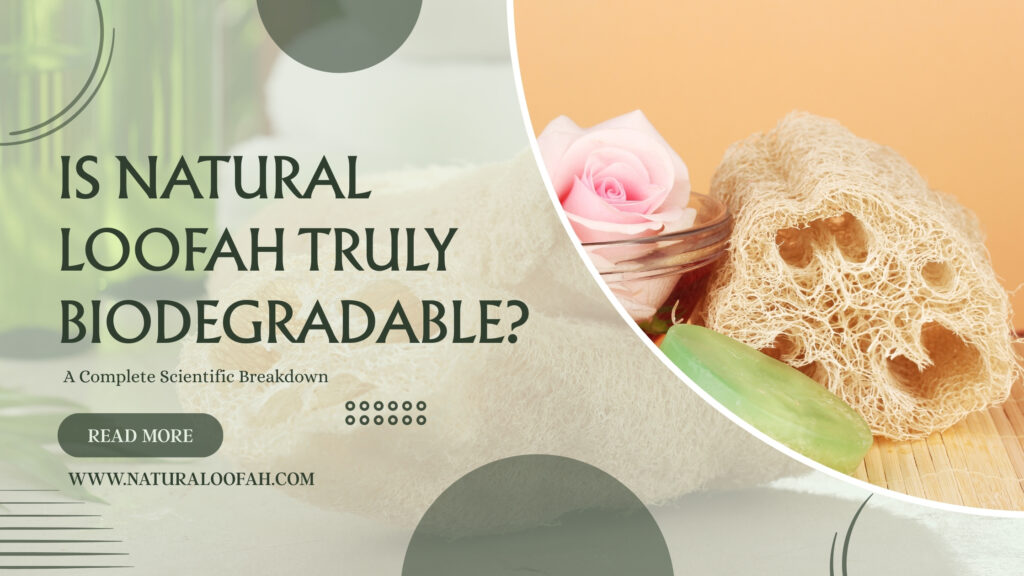
Synthetic bath poufs, nylon scrubbers, and plastic-wrapped sponges sit in landfills for centuries before showing even the slightest signs of breakdown. Against that backdrop, one question keeps surfacing among shoppers, spa owners, retailers, and zero waste advocates alike: is loofah biodegradable?
The short answer is yes, but the full answer involves science, soil conditions, fiber composition, and product quality. Not every loofah on the shelf delivers the same environmental outcome. The species of gourd, the region where it grows, the way it was processed, and the conditions under which it decomposes all shape how quickly and completely a natural loofah returns to the earth.
This guide explains the biodegradability of natural loofah. Whether you are a consumer looking for a genuinely eco-friendly bath product or a wholesale buyer sourcing sustainable inventory for your brand, this article delivers the scientific clarity you need to make informed decisions.
You will find step by step composting instructions and answers to the most commonly asked questions about loofah and the environment. By the end, you will understand not only whether loofah is biodegradable but exactly how, why, and under what conditions it breaks down most effectively.
For those ready to explore biodegradable loofah products right away, request a wholesale quote to get started.
What Makes Loofah Biodegradable at the Molecular Level
Understanding whether loofah is biodegradable starts with understanding what it is made of. A natural loofah is the dried vascular skeleton of the Luffa aegyptiaca gourd, a plant in the Cucurbitaceae family. When you hold a loofah in your hand, you are holding a network of plant fibers composed primarily of three plant polymers: cellulose, hemicellulose, and lignin.
The Fiber Composition of Natural Loofah
Every one of these components is a natural plant material. Soil microorganisms have evolved over millions of years to break down exactly these materials. There is no synthetic polymer, no petroleum derivative, and no persistent chemical in a properly processed natural loofah.
This composition is what separates natural loofah from synthetic alternatives. A nylon bath pouf contains polyamide polymers that no soil organism can metabolize. A natural loofah is essentially food for the microbial ecosystem in healthy soil.
Why Fiber Quality Affects Biodegradability
Not all loofahs are equal in composition. Growing conditions, harvest timing, and processing methods all influence the ratio of cellulose to lignin in the finished product. Loofahs harvested too early tend to have less developed fiber networks with lower cellulose content, which makes them weaker during use but slightly faster to decompose. Loofahs harvested at peak maturity, particularly those grown in the mineral-rich alluvial soil of Egypt’s Nile Delta, develop interlocking fiber networks.
Egyptian loofah is softer, with a looser fibre weave than Asian loofah. EGEXO has been exporting Egyptian loofah since 2015.
Read about EGEXO’s farm to export process.
Summary: Natural loofah is biodegradable because it is made of plant polymers, primarily cellulose, hemicellulose, and lignin, that soil microorganisms naturally consume.
How Long Does It Take for a Natural Loofah to Biodegrade
The question of whether loofah is biodegradable inevitably leads to a follow-up: how fast? The answer depends on the environment where decomposition occurs. A loofah tossed into an active compost pile breaks down far faster than one buried in dry clay soil or left sitting in a landfill with limited oxygen.
For consumers looking to make the switch, bath and body loofahs offer a direct replacement for synthetic poufs. Those interested in extending the concept beyond the shower can explore kitchen loofahs that replace plastic dish sponges, another common source of microplastic waste.
Step by Step Guide to Composting Your Used Natural Loofah
Knowing that loofah is biodegradable is one thing. Knowing how to compost it properly ensures that its end of life impact is as minimal as possible. This process works whether you maintain a backyard compost pile, an indoor worm bin, or simply want to bury a spent loofah in your garden.
Composting Process Table
| Step | Action | Details | Timing |
|---|---|---|---|
| 1 | Confirm the loofah is 100 percent natural | Check for any synthetic string ties, glued labels, or attached plastic. Remove these before composting. Only pure plant fiber should go in. | Before composting |
| 2 | Rinse the loofah thoroughly | Remove soap residue, dead skin cells, and any remaining moisture. A brief soak in clean water followed by a squeeze is sufficient. | Day of retirement |
| 3 | Cut into smaller pieces | Use scissors or garden shears to cut the loofah into pieces roughly 1 to 2 inches in size. Smaller pieces expose more surface area to microbial activity and speed decomposition. | Day of retirement |
| 4 | Add to compost as a brown material | Loofah counts as a carbon-rich brown material. Layer it with nitrogen-rich green material like food scraps, grass clippings, or coffee grounds at a ratio of roughly 3 parts brown to 1 part green. | Day of retirement |
| 5 | Maintain moisture and aeration | Keep the compost pile moist but not waterlogged. Turn the pile every 5 to 7 days to introduce oxygen, which is critical for aerobic decomposition. | Ongoing |
| 7 | Harvest finished compost | Once the loofah pieces are no longer identifiable and the compost has a dark, earthy appearance, it is ready to use in gardens or potted plants. | When the compost is ready |
This process applies equally to individual consumers composting a single loofah at home and to businesses managing larger volumes of product waste. Spas, hotels, and wellness centers that replace loofahs on a set rotation schedule can incorporate used product directly into on-site composting or partner with municipal composting services.
For businesses exploring loofah product lines with strong sustainability narratives, EGEXO’s custom product design services allow you to build branded compostable products that align with your environmental commitments.
Is Loofah Biodegradable When It Has Been Treated or Processed
This is a critical question that many biodegradability discussions overlook. A raw loofah gourd fresh from the vine is undeniably biodegradable. But what happens after processing? Does cleaning, bleaching, or packaging alter the loofah’s ability to decompose?
How Processing Methods Affect Biodegradability
| Processing Method | Common Purpose | Impact on Biodegradability | Notes |
|---|---|---|---|
| Water washing and seed removal | Basic cleaning and preparation | No impact, fully biodegradable | Standard first step in all processing |
| Sun drying | Moisture removal for shelf stability | No impact, fully biodegradable | Preserves natural fiber structure |
| Synthetic dye application | Color customization | Moderate impact depending on dye type | Synthetic dyes may persist longer than plant fiber |
| Plastic string binding | Hanging loop or decorative feature | The string does not biodegrade, must be removed | Always separate before composting |
| Plastic shrink wrap packaging | Retail presentation | Packaging does not biodegrade, must be removed | Look for paper or compostable packaging alternatives |
The takeaway is straightforward. A natural loofah washed and dried by natural methods remains fully biodegradable. Our standard loofah is not bleached. Bleaching is done only on request. Problems arise only when synthetic materials are added during finishing, packaging, or retail presentation.
This is where supplier quality becomes directly relevant. EGEXO dries its loofah by natural methods. Read EGEXO’s quality standards.
For wholesale buyers, verifying processing methods should be a standard part of supplier evaluation. A loofah marketed as biodegradable but bound with nylon string and wrapped in plastic film sends a contradictory message that informed consumers will notice. Choosing a supplier with transparent, eco-aligned processing protects both your brand credibility and your customers’ trust.
Summary: Pure natural loofah remains fully biodegradable after standard processing methods like water washing and sun drying. Only the addition of synthetic materials such as plastic ties, chemical bleach, or synthetic dyes can compromise its decomposition profile.
For businesses evaluating suppliers, request samples to compare fiber, weight, and structural integrity before committing to bulk orders. Samples are paid and the buyer pays the shipping. The sample cost is credited to your first order of $1,000 or more, placed within 60 days.
Supplier Evaluation Checklist for Biodegradable Loofah Products
| Evaluation Criteria | Why It Matters | How to Verify |
|---|---|---|
| 100 percent natural fiber confirmation | Ensures genuine biodegradability claims | Request material composition documentation |
| Processing method transparency | Confirms no synthetic additives used | Ask for written processing procedures |
| Harvest timing and maturity standards | Affects fiber density and lifespan | Request growing and harvest protocol details |
| Packaging material composition | Plastic packaging contradicts biodegradable product | Inspect sample packaging, ask about alternatives |
| Certifications and compliance documentation | Validates claims for retail and regulatory requirements | Request certificates, phytosanitary documents |
| Minimum order terms | Allows testing before large commitment | Discuss MOQ options during initial contact |
| Private label and custom design capability | Supports branded product development | Inquire about branding services and design options |
EGEXO has been exporting Egyptian loofah since 2015. Loofah from own and partner farms in the Nile Delta, processed in EGEXO’s own factory.
For a complete overview of available product types and ordering options, download the full EGEXO product catalog.
Beyond the Bathroom: Where Biodegradable Loofah Fits in a Zero Waste Lifestyle
The biodegradability of loofah makes it valuable far beyond the shower. Once you understand that loofah is biodegradable and performs well as a scrubbing tool, its applications expand into kitchens, cleaning routines, pet care, spa treatments, and even gardening.
For consumers exploring these different uses, raw loofah scrubbers offer the most versatile starting point, as they can be cut, shaped, and adapted to any of the applications listed above. For spa and pet care businesses, pet and spa grooming loofahs are designed specifically for those environments.
For retailers and distributors looking to build a comprehensive biodegradable product line, EGEXO’s private label manufacturing supports branded collections across all of these categories from a single supply source. The ability to offer your customers a complete range of compostable cleaning and personal care tools, all sourced from one trusted supplier, simplifies inventory management and strengthens your brand’s sustainability story.
FAQ Section
Q1: Is loofah biodegradable in all conditions?
A: Yes, natural loofah is biodegradable in virtually all natural environments because it is composed entirely of plant-based cellulose, hemicellulose, and lignin. It decomposes fastest in active compost systems. Natural loofah is a plant fibre and releases no microplastics or persistent pollutants.
Q2: How can I verify that a loofah product is genuinely biodegradable before buying in bulk?
A: Request material composition documentation from your supplier to confirm 100 percent natural Luffa aegyptiaca fiber with no synthetic additives. Check that packaging materials are also compostable or recyclable. Order samples and test them by soaking in water for 48 hours to see if any synthetic components become visible. A reputable supplier will explain its processing and its sample terms.
Q3: Does bleaching or processing make loofah less biodegradable?
A: Mild processing methods like water washing and natural drying do not meaningfully affect biodegradability. The main concern is added synthetic materials such as nylon string ties, plastic hang tags, or synthetic dyes. Always remove non-natural attachments before composting.
Q4: Can I compost my loofah at home without a compost bin?
A: Yes. Cut the spent loofah into small pieces, roughly 1 to 2 inches, and bury them 4 to 6 inches deep in garden soil. You can also place pieces directly around the base of plants as plant mulch that gradually breaks down and adds structure to the soil.
Q5: What is the minimum order quantity for biodegradable loofah wholesale orders?
A: No minimum order on standard products. Private label from 1,000 units. Samples are paid and the buyer pays the shipping. The sample cost is credited to your first order of $1,000 or more, placed within 60 days.
Q7: Does the country of origin affect loofah biodegradability?
A: The country of origin does not change whether loofah is biodegradable, since all natural Luffa aegyptiaca is composed of the same organic polymers.
Q8: Can hotels and spas compost used loofah products at scale?
A: Yes. Hospitality businesses can collect used loofahs in designated bins and partner with commercial composting services for regular pickup. Because natural loofah contains no synthetic materials when properly sourced, it qualifies for most municipal and commercial composting programs. Some facilities even maintain on-site compost systems, turning used loofahs into garden soil for landscaping.
Expert Insight from EGEXO
EGEXO has been exporting Egyptian loofah since 2015. Loofah from own and partner farms in the Nile Delta, processed in EGEXO’s own factory. Natural loofah is a plant fibre, and the fiber that scrubs your skin today returns to the soil as plant matter when it is composted. Request a quote.
Conclusion
The science is clear and the evidence is consistent. Natural loofah is 100% biodegradable, returning entirely to plant matter without leaving microplastics or synthetic residues. Its fiber composition of cellulose, hemicellulose, and lignin is exactly what soil microorganisms have evolved to break down efficiently.
For consumers, this means a simple swap from plastic bath pouf to natural loofah eliminates one of the most common sources of bathroom waste. For businesses, stocking genuinely biodegradable loofah products meets rising consumer demand for sustainable goods and creates a product story backed by verifiable science rather than vague green claims.
Quality matters as much as material.
Key Takeaways:
- Natural loofah is 100% biodegradable, made of plant cellulose, hemicellulose, and lignin
- EGEXO dries its loofah by natural methods, and the loofah stays fully biodegradable
- Loofah qualifies for home composting, commercial composting, vermicomposting, and direct soil burial
Ready to experience Egyptian loofah quality?
- For wholesale orders: Request a quote or request samples